Skip to content
Kalamazoo Foundation Repairs

Serving Kalamazoo and nearby areas

Stair-Step Cracks in Foundation Walls in Kalamazoo, MI

A stair-step crack in a Kalamazoo block or brick wall can mean a corner is settling or the wall is being pushed, so get a free inspection and a written price.

Book a free foundation inspection

Tell us what you are seeing. A local specialist calls you back the same business day.

Local to Kalamazoo

We connect property owners in Kalamazoo and nearby areas, including Vine, Stuart, South Street, Westnedge Hill, Edison and Portage, with one independent local foundation repair specialist.

  • Soil that changes from yard to yard

    A USGS study of the Kalamazoo area describes sandy outwash plains next to moraines made mostly of slow draining till. One end of a house can sit on firmer ground than the other.

  • Old mortar

    The city dates South Street homes to 1841 to 1915 and the Stuart district to the late 1800s. Mortar that old has had more than a century of freeze and thaw.

What it costs

Typical published ranges for Kalamazoo. The contractor's written estimate is the price, and the inspection is free.

WorkTypical range
Inspection and written estimate Free
Crack sealing $200 to $1,000per crack
Tuckpointing, walls 8 feet or under $5 to $10per sq ft
Carbon fiber straps, whole job $4,000 to $12,000
Piers for a settling corner $1,000 to $3,000each
Structural engineer report $300 to $2,000

See typical foundation repair prices in Kalamazoo

What a stair-step crack looks like

A stair-step crack zigzags up a block or brick wall. It follows the mortar joints, so it goes over one block, up one row, over again. It looks like a set of stairs.

You will often see it:

Near a corner

Running up and away from the corner at an angle.

Under a window

Starting at a basement window corner and stepping down.

At the end of a sideways crack

Where a bowing wall bends near the corners.

On both sides of a wall

A crack inside that shows up outside too.

With a wider end

Open at the top, tight at the bottom, or the other way.

With shifted blocks

One block sits out from the ones next to it.

Why Kalamazoo block walls crack this way

Block and brick walls are stacked units held by mortar. Mortar is the weak link. When the wall moves, it cracks along the joints and makes the step shape.

In Kalamazoo, two kinds of movement cause most of them.

One corner settles. Kalamazoo sits on glacial ground. The USGS describes sandy outwash next to moraines that are mostly till, a packed clay and rock mix. The USDA soil survey shows loam and clay loam on top, then sand and gravel a few feet down. Ground like that can be firm in one spot and softer a few feet away. If one corner of a house sinks more than the rest, the wall above it cracks in steps.

The wall gets pushed. Michigan's code puts the frost line at 42 inches. Wet soil freezes against the upper wall each winter and pushes it in. A wall pushed in the middle often cracks sideways across the middle and in steps near the ends.

Age adds to both. About 3 in 10 homes in the city were built before 1940. Mortar in older walls is often softer and worn, so it cracks sooner.

Cosmetic or urgent?

The shape tells part of the story. The pattern and change over time tell the rest. Inspection guides say a step crack should lead to a check of the whole foundation, not just the crack.

Lower concern. A thin, dry crack in an old wall that has not changed. No bowing. Doors and floors upstairs are fine.

Have it checked soon. The crack is wider at one end. It leaks. It is new since last winter. A crack shows up in the same spot outside.

Call now. Blocks have shifted out of line. The wall bows. A corner has dropped and you can see it in the floor or the brick outside. Doors and windows above that corner started to stick.

How it is usually fixed

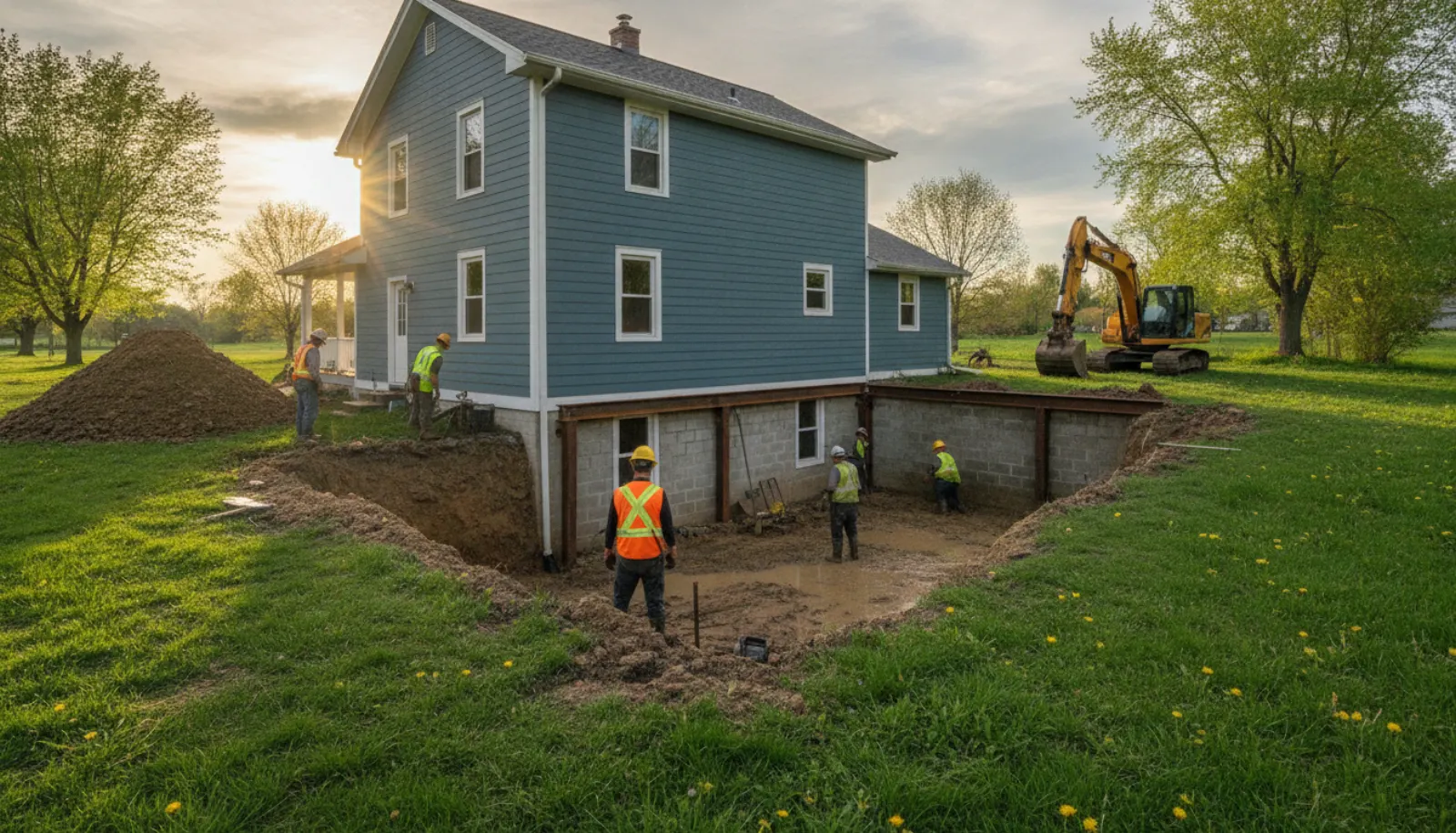
The contractor we connect you with first finds out which kind of movement caused it. The fix follows the cause.

  1. Seal and tuckpoint. For a stable crack, the crew cleans out the joint and packs in new mortar or seals it. This keeps water out.
  2. Drainage. Downspouts, grading and gutters are fixed so the soil near that corner stays drier and firmer.
  3. Wall bracing. If the wall is being pushed in, straps, steel beams or anchors hold it.
  4. Piers. If a corner is settling, steel piers are driven down to firmer soil and the corner is set on them.
  5. Rebuild the section. Badly shifted blocks may be taken out and relaid.

An engineer's report may be useful if a corner has settled a lot or you are selling the house.

What it costs

The cost table on this page shows typical ranges from Fixr cost guides, not a quote. A stable crack may only need sealing or tuckpointing. A settling corner that needs piers costs much more.

What to do before the inspection

  1. Mark the top and bottom of the crack with a pencil and date it.
  2. Measure the width at the widest point. A coin works as a gauge.
  3. Check the outside of the same corner for a matching crack.
  4. Look upstairs for cracks over doors and windows near that corner.
  5. Fix any downspout that dumps water at that corner.
  6. Take photos so you can compare them in a few months.

Frequently asked questions

Are stair-step cracks in a block foundation normal?

Small ones are common in older block and brick walls. A thin, dry crack that has not changed may be minor. A crack that widens, leaks, or comes with a wall that bows or a corner that drops needs a closer look.

What causes stair-step cracks?

Usually one part of the wall moving more than another. That can be a corner settling into soft soil, frost pushing in on the wall, or water pressure behind it. The crack follows the mortar because mortar is weaker than block.

How wide is too wide?

There is no single number, but a crack you can slide a coin into, or one wider at one end than the other, is worth having checked. A crack where one side sticks out past the other also points to movement.

Can I fix a stair-step crack with mortar?

You can fill it, but that does not fix the cause. If the corner is still settling or the wall is still being pushed, a new crack will form. Inspectors also note that a patched crack does not prove the problem was solved.

Do I need a licensed contractor in Michigan?

For most jobs, yes. Michigan law says home repair work of $600 or more must be done by a licensed residential builder or maintenance and alteration contractor.

Have the crack looked at

Call (269) 448-7655 or send the short form. A local crew will call you back, look at the wall and the corner for free, and give you a written price if it needs work.

(269) 448-7655 Free inspection