Skip to content
Kalamazoo Foundation Repairs

Serving Kalamazoo and nearby areas

Horizontal Crack in Basement Wall in Kalamazoo, MI

A horizontal crack in a Kalamazoo basement wall usually means soil is pushing on it, so book a free inspection and get a written price before another winter.

Book a free foundation inspection

Tell us what you are seeing. A local specialist calls you back the same business day.

Local to Kalamazoo

We connect property owners in Kalamazoo and nearby areas, including Vine, Stuart, South Street, Westnedge Hill, Edison and Portage, with one independent local foundation repair specialist.

  • 42 inches of frost

    Michigan's building code sets the frost line at 42 inches and calls weathering severe. The soil against the top of your basement wall freezes every winter, and frozen wet soil pushes.

  • Clay loam near the surface

    USDA lists the Kalamazoo soil as loam over clay loam in the top few feet, with sand below. Clay loam holds water near the top of the wall, right where frost bites.

  • Wet springs

    In April 2026 the city declared an emergency after high groundwater flooded basements across town. Soil that wet weighs more and pushes harder on every wall.

What it costs

Typical published ranges for Kalamazoo. The contractor's written estimate is the price, and the inspection is free.

WorkTypical range
Inspection and written estimate Free
Crack sealing, wall not moving $200 to $1,000per crack
Carbon fiber or steel straps $85 to $275per foot of wall
Wall anchors $80 to $150per foot of wall
Strap job, whole wall or house $4,000 to $12,000
Wall straightening $335 to $550per foot of wall

See typical foundation repair prices in Kalamazoo

What a horizontal crack looks like

A horizontal crack runs sideways along the wall, not up and down. In a block wall it usually follows one mortar joint. It is often near the middle of the wall or in the upper third. In a poured wall it may be a thin line a foot or two below the top.

Look for these clues next to it:

A long, straight line

It runs several feet, often most of the wall.

A lip at the crack

The blocks above or below stick out past the others.

A bulge

The middle of the wall leans into the basement.

Water or a white crust

Damp blocks along the crack after rain or melt.

Cracks at the ends

Short stair-step cracks near the corners, where the wall bends.

A gap at the top

Space between the wall and the wood sill plate above it.

Why Kalamazoo walls crack sideways

A basement wall holds back soil on one side and air on the other. When the soil gets heavy, the wall bends inward. Block walls are weak in that direction, so the mortar joint near the middle lets go first.

Three local things make that push stronger here.

First, the frost. Michigan's code puts the frost line at 42 inches. The top three to four feet of soil next to your wall freezes each winter. Wet soil swells as it freezes and shoves the wall in.

Second, the soil. The common Kalamazoo soil is loam over clay loam for the first few feet, then sand and gravel below. The clay loam holds water near the top of the wall. That is the same zone that freezes.

Third, the water. Kalamazoo gets about 70 inches of snow a year, and it all melts in spring. A 1960 USGS study of the area found that the moraines, the low glacial hills, are mostly till, a packed clay and rock mix that drains slowly. Soil that stays wet stays heavy.

Cosmetic or urgent?

Many sideways cracks are old and stable. Home inspectors see them in block homes all the time. But you cannot tell by looking at the crack alone. These steps help sort it out.

Lower concern. The crack is thin, dry and has not changed in a year. A level held from top to bottom sits flat on the wall.

Have it checked soon. The crack is new, wider at the middle than the ends, or leaks. A level shows a gap at the middle. One row of blocks sticks out.

Call now. The wall bows more than an inch or two, the bottom has slid in past the floor, or the crack grew over one winter. Doors upstairs started sticking at the same time.

How it is usually fixed

The fix depends on how far the wall has moved. The contractor we connect you with measures the bow and picks one of these.

  1. Seal and watch. If the wall is straight and dry, the crack can be sealed and marked. Gutters and grading get fixed so the soil stays drier.
  2. Carbon fiber straps. Thin strips glued to the wall every few feet. They hold a wall that has bowed only a little. They do not take space and can be painted.
  3. Steel beams. Steel posts bolted to the floor and the house framing. They hold walls with more bow and can sometimes be tightened.
  4. Wall anchors. Rods run through the wall to plates buried in the yard. Tightening them over time can pull the wall back some.
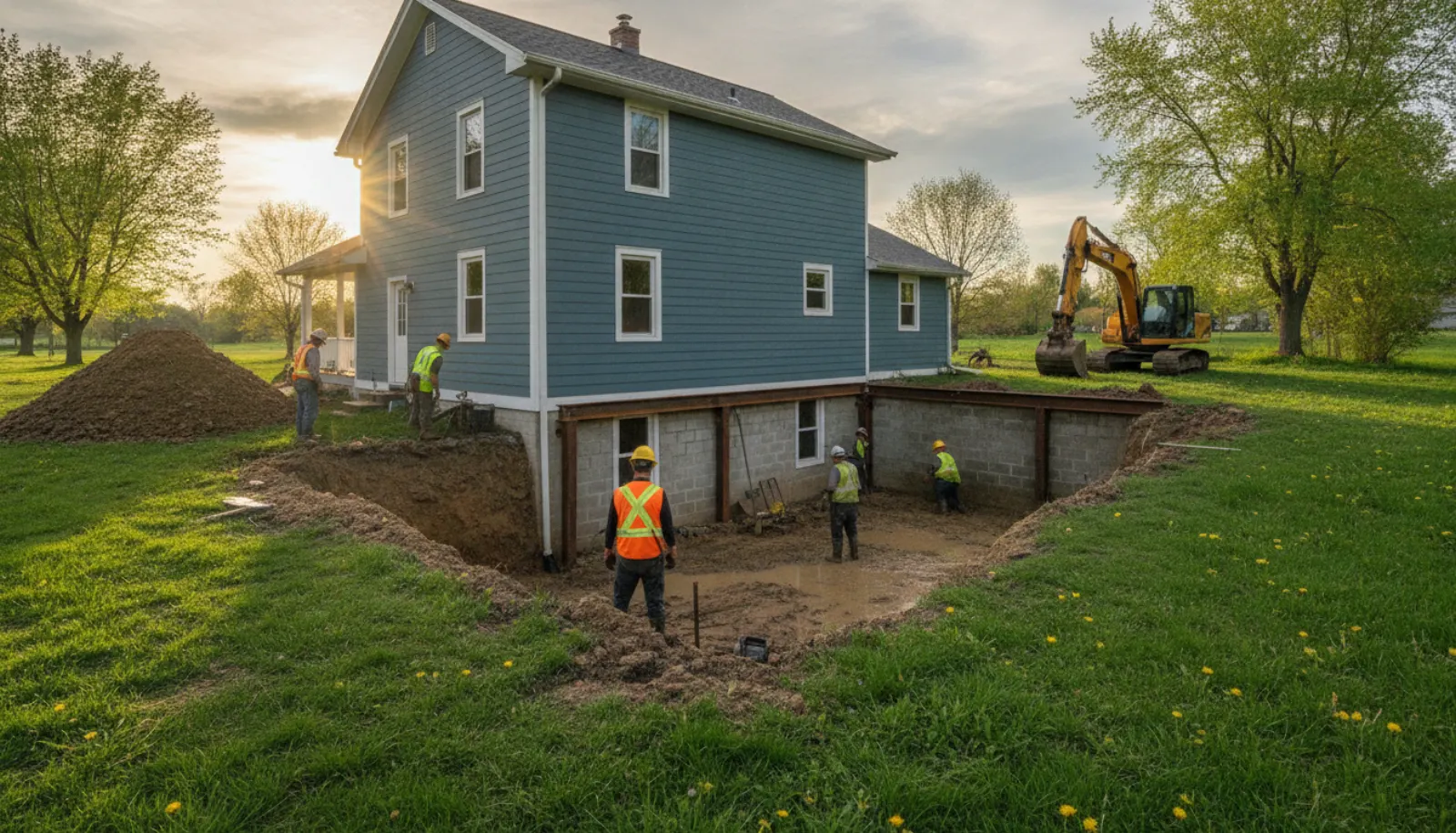
  5. Dig and rebuild. If the wall has moved too far, the crew digs outside and rebuilds or straightens it.

Most plans also fix the water: downspout extensions, soil that slopes away from the house, or a drain. Structural work like bracing often needs a permit. In the City of Kalamazoo, permits go through Community Planning and Development.

What it costs

The cost table on this page shows typical ranges from the Fixr and Today's Homeowner cost guides, not a quote. The two things that move the price most are how many feet of wall need bracing and whether the wall has to be dug out.

What to do before the inspection

  1. Clear a path to the cracked wall. Move shelves and boxes if you can.
  2. Hold a long level or a tight string against the wall at the crack. Note any gap.
  3. Mark both ends of the crack with a pencil and write the date.
  4. Take photos with a ruler or coin for size.
  5. Point downspouts at least a few feet away from that wall.
  6. Note when water shows up: after rain, after snow melt or all spring.

Frequently asked questions

Is a horizontal crack in a basement wall serious?

It can be. Most sideways cracks come from soil pushing in on the wall, not from concrete drying out. Have any horizontal crack looked at, even a thin one, so you know if the wall is moving.

My horizontal crack has been there for years. Do I still need to worry?

Many block homes have an old sideways crack that has not changed in decades. The question is whether it is still moving. A level or string line shows if the wall bows. If it does not bow and the crack does not grow or leak, you may only need to fix drainage and keep watching.

Can I just fill the crack myself?

Filling it hides the crack, but it does not stop the push. If the wall is moving, the crack will open again or show up somewhere else. Patch only after you know the wall is stable.

Why is the crack about halfway up my block wall?

That is where the push from wet and frozen soil bends a block wall the most. The mortar joint near the middle gives first. In poured walls the crack is often closer to the top.

Will a horizontal crack hurt my home sale?

Buyers and their inspectors look for it. A repair with a written warranty and permit, if one was needed, is easier to explain than an open crack.

Get the crack checked

A sideways crack is easier and cheaper to stop before another freeze. Call (269) 448-7655 or send the short form. A local foundation crew will call you back, look at the wall for free and give you a written price if it needs work.

(269) 448-7655 Free inspection